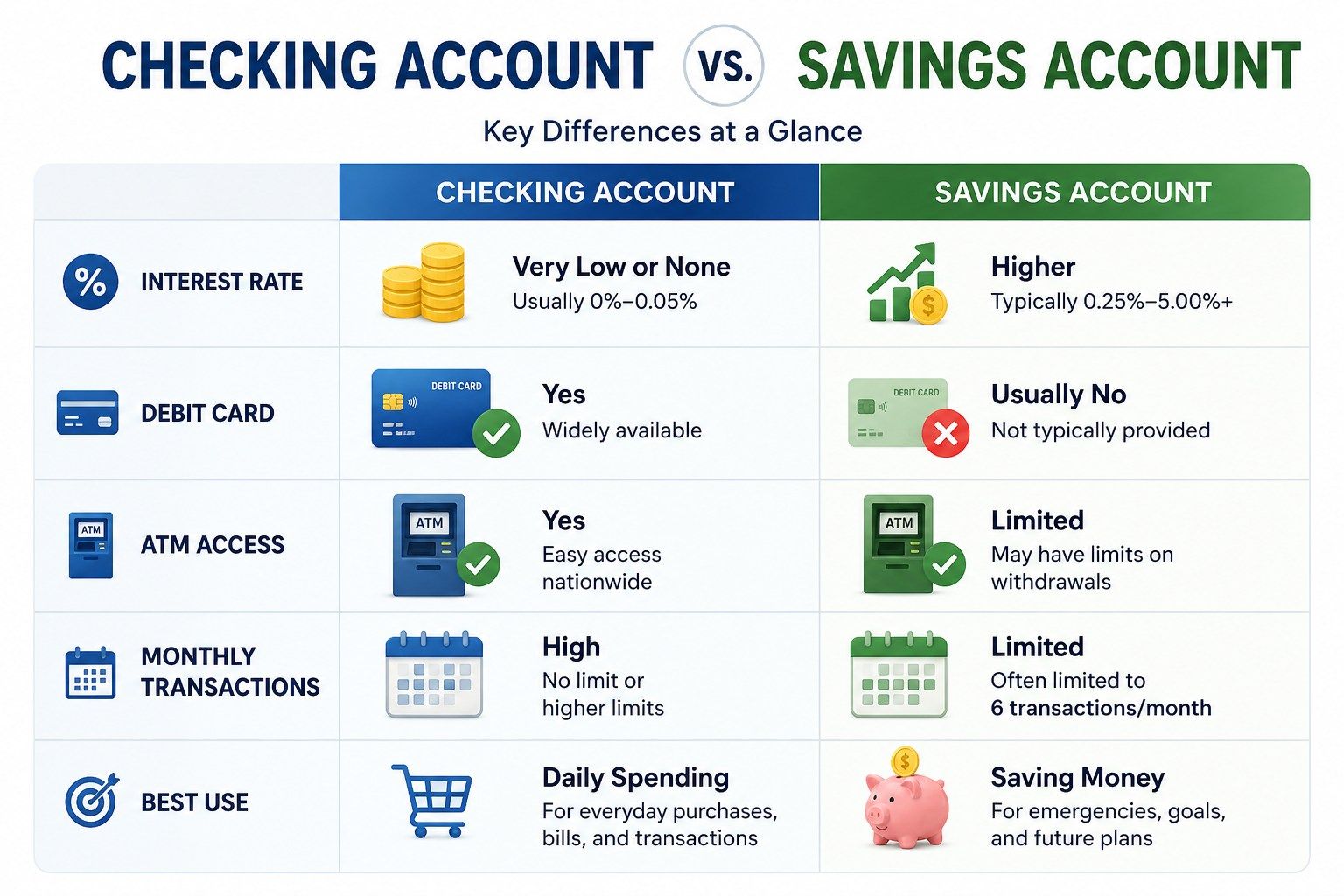
Few financial decisions shape day-to-day life as quietly and as profoundly as choosing where to keep your money. Checking and savings accounts form the foundation of nearly every personal financial strategy, yet many account holders never examine how these instruments actually function. Understanding their mechanics, differences, and optimal use cases empowers you to manage cash flow, earn interest, and avoid unnecessary fees. This guide breaks down both account types in clear, practical terms.
What Is a Checking Account?
A checking account is a transactional deposit account designed for frequent access to your funds. It serves as the operational hub of your financial life, handling routine inflows such as payroll deposits and routine outflows such as rent, utilities, and card purchases. Because liquidity is the priority, checking accounts typically pay little or no interest.
Core Features of Checking Accounts
- High liquidity: Funds are available on demand via debit card, check, ATM, or electronic transfer.
- Direct deposit capability: Employers and government agencies can deposit wages and benefits automatically.
- Bill payment tools: Most institutions offer online bill pay, automatic transfers, and recurring payment scheduling.
- Overdraft options: Some accounts permit transactions beyond your balance, often for a fee or with linked protection.
- Low or no minimum balance: Many accounts waive monthly fees when you meet deposit or activity thresholds.
Common Checking Account Variations
Not all checking accounts are identical. Financial institutions design them around different customer profiles:
What Is a Savings Account?
A savings account is a deposit account intended for accumulation rather than daily spending. You deposit funds and leave them to grow, earning interest over time. Savings accounts traditionally limited withdrawals, and while federal withdrawal limits were relaxed in 2020, many banks still impose their own caps or fees for excess transactions.
Core Features of Savings Accounts
- Interest earnings: Balances accrue interest, typically compounded daily or monthly.
- Reduced spending temptation: Limited transfer options discourage casual withdrawals.
- Emergency fund suitability: Funds remain accessible while being deliberately separated from daily cash.
- Deposit insurance: Federally insured up to applicable limits, protecting principal against institutional failure.
- Goal-based structure: Ideal for short- and medium-term objectives such as travel, tuition, or a down payment.
Specialized Savings Vehicles
Banks and credit unions offer several savings variants to match different goals:
- High-yield savings accounts (HYSAs): Online-first accounts paying significantly higher rates with fewer overhead costs.
- Money market accounts: Hybrid accounts combining higher interest with limited check-writing or debit access.
- Certificates of deposit (CDs): Fixed-term deposits with guaranteed rates, trading liquidity for higher yields.
- Health savings accounts (HSAs): Tax-advantaged accounts for qualified medical expenses, with investment options.
Checking vs. Savings: A Side-by-Side Comparison
| Primary purpose | Daily transactions and bill payments | Accumulating funds and earning interest |
| Access to funds | Immediate and unlimited | Accessible but often limited per month |
| Interest rate | Minimal or none | Typically higher, especially with HYSAs |
| Typical fees | Monthly maintenance, overdraft, ATM | Excess withdrawal, minimum balance |
| Best use case | Everyday spending and income deposits | Emergency reserves and goal saving |
| Debit card access | Usually included | Often limited or unavailable |
How the Two Accounts Work Together
The most effective banking strategy treats checking and savings accounts as complementary tools rather than competing options. A practical framework looks like this:
Key Factors When Choosing an Account
Institutional choice matters as much as account type. Evaluate providers against the following criteria:
- Fees: Scrutinize monthly maintenance charges, overdraft policies, and out-of-network ATM costs.
- Interest rates: Compare annual percentage yields (APYs), particularly for savings.
- Insurance: Confirm FDIC or NCUA coverage to protect your deposits.
- Digital tools: Assess mobile apps, fraud alerts, and integration with budgeting software.
- Access network: Consider branch availability and fee-free ATM partnerships.
- Customer support: Verify reachable human assistance across phone, chat, and in-person channels.
Conclusion
Checking and savings accounts serve distinct but interlocking roles. The checking account powers your financial operations, while the savings account builds your financial resilience. Used together with automation and periodic review, they create a stable framework for managing money with confidence. Whether you are opening your first account or reassessing long-held ones, prioritize low fees, competitive rates, and tools that align with how you actually spend and save. Sound banking begins with understanding, and that understanding starts here.
Leave a Reply