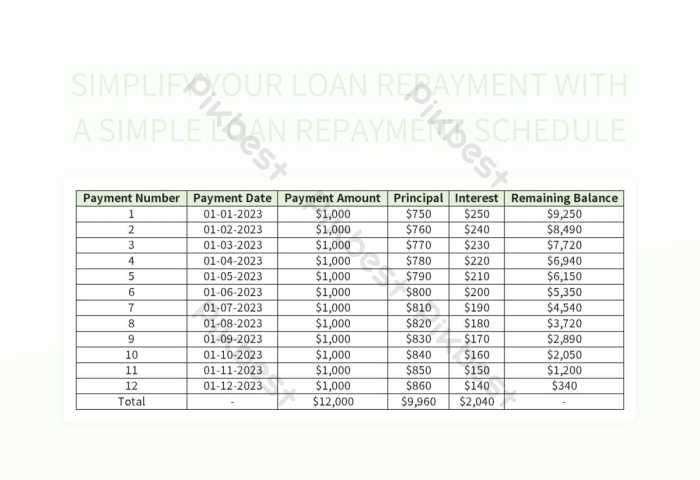
Every loan agreement rests on a simple promise: the borrower receives a principal amount today and commits to returning it, plus interest, over a defined period. The mechanism that translates this promise into a concrete series of payments is the loan repayment schedule. For anyone building, evaluating, or integrating financial technology, a precise understanding of repayment schedules is not optional. It is the foundation on which amortization engines, credit risk models, and payment platforms are built.
This article breaks down how repayment schedules function, the mathematics behind the most common structures, and the practical implications for borrowers and technologists alike.
What Is a Loan Repayment Schedule?
A loan repayment schedule is a structured timeline that details each payment required to fully retire a debt. It specifies the payment amount, the due date, the portion allocated to principal, and the portion allocated to interest for every installment across the life of the loan.
Two components define any schedule:
- Principal: The original sum borrowed, or what remains outstanding at any point in time.
- Interest: The cost of borrowing, calculated as a percentage of the outstanding balance over a given period.
The interplay between these two elements determines how quickly a borrower builds equity and how much they ultimately pay for access to capital.
The Core Structures: Amortizing vs. Interest-Only vs. Balloon
Not all schedules distribute principal and interest the same way. The three dominant structures each serve different lending contexts.
Amortizing Loans
An amortizing loan features equal total payments spread across the loan term. Early payments are weighted heavily toward interest; later payments shift toward principal. By the final installment, nearly the entire payment reduces the remaining balance. Mortgages, auto loans, and personal installment loans typically follow this model.
The defining characteristic is that the loan reaches a zero balance precisely at the end of the term, provided all payments are made on schedule.
Interest-Only Loans
With an interest-only structure, the borrower pays only the accrued interest for a specified period. No principal is reduced during this phase. Once the interest-only period ends, the loan either converts to an amortizing structure or requires a full principal repayment.
This structure lowers initial monthly obligations but increases later payments and total interest cost. It appears frequently in construction financing and certain mortgage products.
Balloon Loans
A balloon loan combines low periodic payments with a single, large payment due at maturity. The periodic payments may cover interest only or a small portion of principal. The balloon payment, often substantial, retires the remaining balance in one transaction.
Balloon structures suit short-term financing where the borrower expects to refinance or sell an underlying asset before maturity.
The Mathematics of Amortization
The standard amortization formula calculates a fixed periodic payment that fully repays principal and interest over a set number of periods. The formula is:
M = P × [r(1 + r)^n] / [(1 + r)^n − 1]
Where:
- M = periodic payment
- P = principal loan amount
- r = periodic interest rate (annual rate divided by number of periods per year)
- n = total number of payment periods
Each payment M is applied first to the interest accrued on the current balance, with the remainder reducing principal. This allocation shifts gradually over time, a phenomenon known as amortization.
Sample Amortization Schedule
Consider a $10,000 loan at 6% annual interest with a 12-month term. The monthly payment is approximately $860.66. The schedule below illustrates how the allocation changes.
| 1 | $860.66 | $50.00 | $810.66 | $9,189.34 |
| 2 | $860.66 | $45.95 | $814.71 | $8,374.63 |
| 3 | $860.66 | $41.87 | $818.79 | $7,555.84 |
| 4 | $860.66 | $37.78 | $822.88 | $6,732.96 |
| 5 | $860.66 | $33.66 | $827.00 | $5,905.96 |
Note the trend: interest declines each period while principal reduction accelerates. Over the full term, total interest paid amounts to approximately $327.92.
Why Repayment Schedules Matter in Fintech
For software architects and product managers, repayment schedules are not abstract finance concepts. They are computational requirements embedded in core systems.
- Amortization engines must generate accurate schedules in real time, accounting for variable rates, irregular payment dates, and prepayments.
- Payment processing platforms rely on schedule data to reconcile transactions, detect delinquencies, and trigger automated reminders.
- Risk and underwriting models use scheduled cash flows to estimate default exposure and calculate metrics such as weighted average life and duration.
- Regulatory reporting demands precise amortization data for disclosures, tax documentation, and compliance audits.
Errors in schedule generation cascade through every downstream system: misstated balances, incorrect interest accruals, and failed reconciliations. Precision is non-negotiable.
Factors That Alter a Repayment Schedule
Real-world loans rarely follow a pristine timeline. Several events modify the schedule mid-stream.
Each event demands robust recalculation logic. A system that cannot handle these variations will fail under production conditions.
Designing Systems That Handle Repayment Schedules
When building or selecting a loan management platform, prioritize the following capabilities:
- Support for multiple schedule types: Amortizing, interest-only, balloon, and custom structures.
- Flexible interest calculation: Simple, compound, and day-count conventions such as 30/360 or actual/365.
- Event-driven recalculation: The ability to adjust schedules in response to payments, rate changes, and borrower actions.
- Auditability: A complete history of schedule versions and the events that triggered each change.
- API accessibility: Programmatic access to schedule data for integration with payment, accounting, and reporting systems.
The best implementations separate the amortization engine from business logic, allowing the same computational core to serve mortgages, consumer credit, and commercial lending without modification.
Conclusion
Loan repayment schedules convert a lending agreement into an executable sequence of cash flows. Whether structured as amortizing, interest-only, or balloon, the schedule defines how principal and interest interact over time. For borrowers, understanding this mechanics reveals the true cost of credit. For technologists, it defines the computational requirements of the systems they build. Master the schedule, and you master the loan.
Leave a Reply