

In the modern financial ecosystem, your credit score functions as a numerical signature. It is a three-digit algorithmic verdict that determines whether you can rent an apartment, secure a mortgage, finance a vehicle, or even land certain jobs. Yet despite its outsized influence, most consumers treat their credit score as an opaque metric—something that simply happens to them rather than something they actively control. This article dismantles that misconception. We will examine the precise variables that influence your credit score, how they are weighted, and what you can do to engineer a stronger financial profile.
The Anatomy of a Credit Score
Before analyzing individual factors, it is essential to understand what a credit score actually represents. In the United States, the most widely used model is the FICO Score, followed closely by VantageScore. Both systems rely on data pulled from the three major credit bureaus: Equifax, Experian, and TransUnion. Your score is not a static number—it is a dynamic calculation that updates as new information is reported, typically every 30 to 45 days.
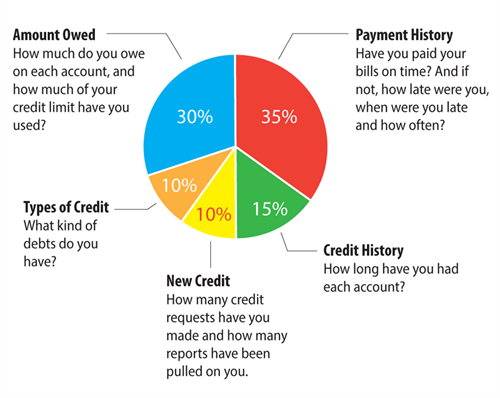
While the exact formulas are proprietary, the general weighting of factors is publicly documented. The table below outlines how FICO typically distributes influence across the key categories.
| Payment History | 35% | Whether you pay on time |
| Credit Utilization | 30% | How much of your available credit you use |
| Length of Credit History | 15% | How long your accounts have been open |
| Credit Mix | 10% | Variety of credit types (cards, loans, etc.) |
| New Credit Inquiries | 10% | Recent applications for credit |
Payment History: The Single Most Critical Variable
If you remember only one thing from this article, remember this: payment history is the foundation of your credit score. Accounting for roughly 35% of your FICO Score, it is the heaviest single factor in the calculation. Lenders want to know one thing above all else—will you repay what you borrow, and will you do so on time?
This category includes several data points:
- On-time payments across all credit accounts
- Late payments, including how recent and how severe they were
- Accounts sent to collections
- Bankruptcies, foreclosures, and settlements
- Public records such as tax liens (where applicable)
A single 30-day late payment can ding your score by 60 to 100 points, depending on your starting position. A 90-day delinquency or a collection account can be catastrophic. The takeaway is unambiguous: automate your payments and never miss a due date.
Credit Utilization: The Ratio That Rules Revolving Credit
Credit utilization is the second-most influential factor, comprising about 30% of your score. It measures the percentage of your available revolving credit that you are currently using. If you have a $10,000 credit limit and a $3,000 balance, your utilization is 30%.
Industry best practice recommends keeping your utilization below 30%, but the highest-scoring consumers typically hover below 10%. Utilization is calculated both per-card and across all accounts, so maxing out a single card can hurt even if your overall ratio looks healthy.
To optimize this factor:
Length of Credit History: The Patience Factor
Accounting for approximately 15% of your score, length of credit history rewards longevity. The calculation considers the age of your oldest account, the age of your newest account, and the average age of all accounts.
This is why closing a decades-old credit card is often a strategic error. Even if you rarely use it, that account contributes positively to your average account age. Consumers with thin or new credit files are penalized not for irresponsibility but simply for lack of tenure. Time, unfortunately, is the only remedy.
Credit Mix: Demonstrating Versatility
Comprising about 10% of your score, credit mix examines whether you can responsibly manage different types of credit—revolving accounts such as credit cards, installment loans such as auto or student loans, and mortgages. A diverse portfolio signals to lenders that you are not a one-trick borrower.
That said, do not open accounts solely to improve your credit mix. The marginal benefit rarely justifies the hard inquiry and the risk of accumulating unnecessary debt.
New Credit Inquiries: The Short-Term Cost of Application
The final 10% of your score reflects your recent credit-seeking behavior. There are two types of inquiries:
- Hard inquiries: Triggered when you apply for credit. These can lower your score by a few points and remain on your report for up to two years.
- Soft inquiries: Triggered by pre-approval checks, employer background checks, or your own credit monitoring. These do not affect your score.
Rate shopping for a mortgage or auto loan is generally treated as a single inquiry if multiple applications occur within a short window—typically 14 to 45 days, depending on the scoring model.
Factors That Do Not Affect Your Credit Score
Just as important as knowing what counts is knowing what does not. The following items are not included in standard credit scoring models:
- Your income or employment status
- Your age, race, gender, or marital status
- Your bank account balances or debit card activity
- Whether you receive government assistance
- Your rental history (unless reported through specialized programs)
Conclusion: Engineering a Stronger Score
Your credit score is not a mystery—it is a computation. Every factor that influences it is within your sphere of control to some degree. Pay on time, keep utilization low, preserve old accounts, apply for new credit sparingly, and let time do its work. Master these variables, and you transform your credit score from a source of anxiety into a strategic asset.